How can Virtual Reality be applied in education?
Education systems have begun to include new tools in classrooms, such as Augmented Reality and Virtual Reality.
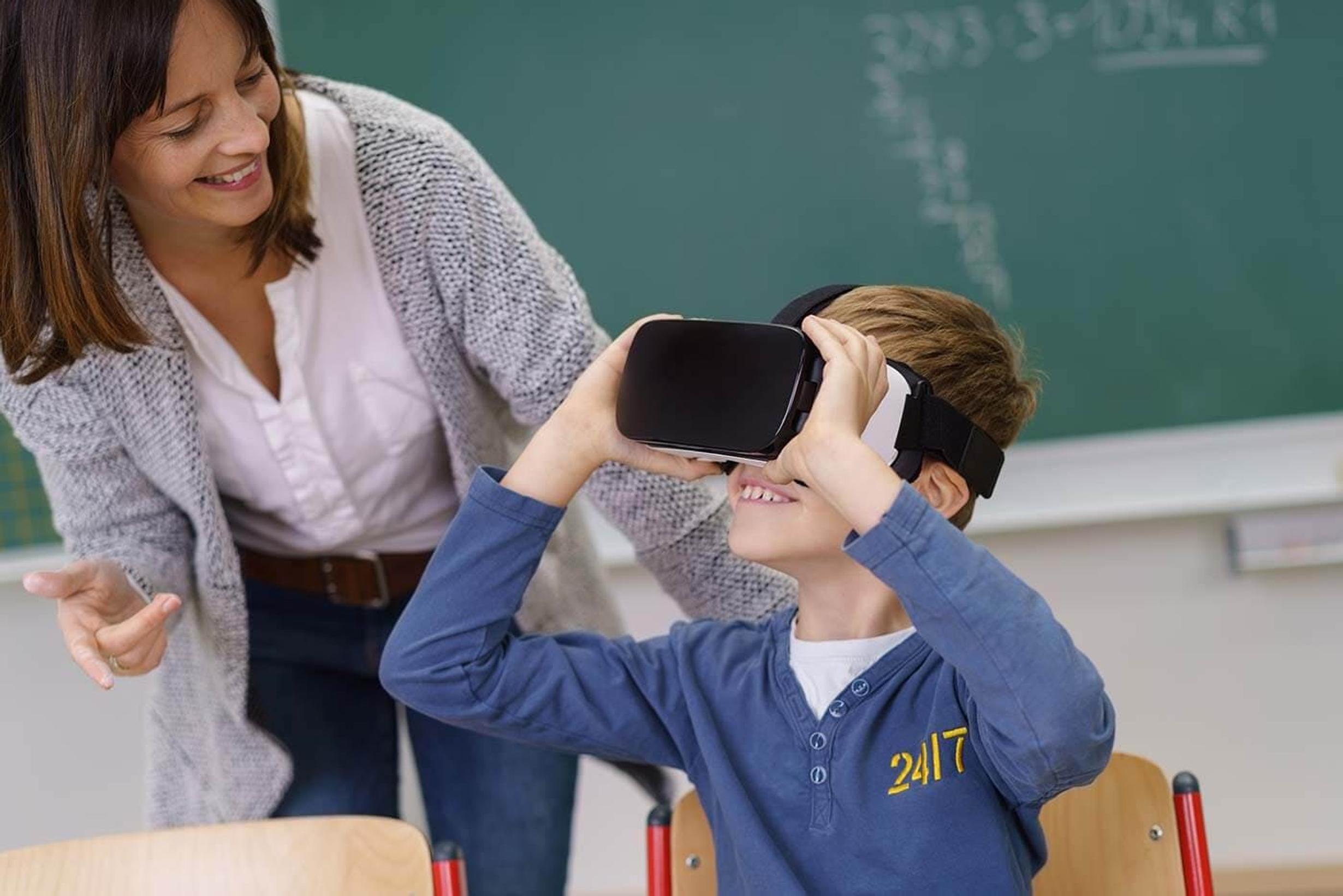
September has arrived, and with it, teachers and students are returning to their desks in schools, secondary schools and universities. A return to routine that is becoming less and less routine. How? Because classrooms are no longer filled only with books: new technologies have now become a very useful resource for learning, and are gradually being applied in the education sector, turning the month of September into a new opportunity to plan new training challenges thanks to new technologies.
Several education systems have begun to include new tools in classrooms, offering a number of very interesting possibilities, and Augmented Reality and Virtual Reality are two of the pillars of this new model that is being developed. As an example, this year, 2019, at INVELON Technologies we have trained the Department of Education of the Generalitat of Catalonia, delivering courses on Virtual and Augmented Reality to Vocational Training teachers. With this training, we are helping educational centres to implement VR and AR technologies more effectively for this new academic year, and both students and teachers can benefit from all the uses these new tools offer in the classroom. Do you know what they are? We tell you all about them in this article:
Possible uses of Virtual Reality
In education, Virtual Reality is in greater demand than Augmented Reality, as it allows the complete recreation of scenarios or situations of interest to the education system. It is also a novelty that can be present at any level, from primary education for the youngest children to degrees or training for more technical and professional profiles. Let us look at some uses within education.
- Travelling to other places and historical moments
With Virtual Reality, the cities of ancient civilisations can be recreated. The youngest children can discover what ancient Egypt was like or see the splendour of the city of Rome. However, this is not something that only serves to spark curiosity in the youngest. Think, for example, of students of History or Art History. Or of Geography students, who can see what the state of certain geographical features used to be. Really, the limit of this functionality would be the precision with which these new maps or spaces would be detailed. And it is precisely that degree of closeness to reality that would determine the educational level they are aimed at.
- A way of understanding history
Not only can we look at the world in other eras, we can also understand it through them. It would be an immersive process through which students could have a much more direct experience of how life worked in a particular place or historical moment. As we shall see later, this type of immersion works very well for awakening students' curiosity and stimulating their imagination and desire to learn even further. And it will be a very effective method for helping them retain information better.
- Exploring different scales
Think of the human body, of galaxies or, for example, of molecules. Virtual reality is excellent for seeing in detail how macroscopic or microscopic structures work. And the same goes, for example, for the human body. In this way, we can gain a much closer and more realistic view of these elements. And, in addition, understand how they work better and connect the knowledge that has been learned. Here, for example, you can see the clear usefulness that virtual reality would have for technical profiles: doctors, physicists, chemists and so on. Although it can also help us in other types of sectors. For example, to understand how an engine works, to analyse the viability of certain parts within a machine and so on.
- An engine for empathy
One way of understanding what others are like is to put ourselves in their shoes. Virtual reality can also reflect certain current dramas that are being lived through, and is especially useful for the more ethical questions within education. It is about understanding, for example, the plight of refugees, what it is like to live through wars or certain physical and psychological problems that a person may experience.
Benefits of using Virtual Reality
Some of them have already been hinted at. Primarily, immersion is the best thing these systems offer, that is, the possibility of taking part in another world and in other circumstances. And where can this lead?
- A boost for creativity
It will greatly stimulate students' creativity, regardless of their level of development or preparation. More visual, holistic knowledge always makes it easier to understand the subject being studied. And so students form a clearer and quicker mental image; in this way, the subject will seem much more appealing to them.
- It allows us to practise
So far it has only been considered as a way of viewing a subject, but it can be a means of practising something safely; for example, driving or even surgical exercises. Virtual reality offers a field in which one can begin to carry out a trade or a delicate job and become better acquainted with the techniques or instruments that will be used.
- It offers more complete knowledge
This type of recreation makes it possible to develop a much more universal intuition. Everything is treated more broadly and different aspects can be brought together in a single image or recreation, which makes for a more complete understanding.
- It helps with empowerment
If we think, for example, of some children with special needs, many of those educational barriers can be overcome with a suitable Virtual Reality solution. It provides a safe space in which to carry out an exercise and is simply one more tool in teachers' hands for explaining a subject properly.
Other applications of Virtual Reality and Augmented Reality
The uses of Virtual Reality and Augmented Reality are not confined to education. This is a functionality you can find in a great many sectors; these are some examples:
- Architecture.
- Design departments
- Industrial maintenance
- Healthcare and Medicine
- Logistics and warehouse management
- Advanced information visualisation
- Risk prevention and simulation of hazardous situations
- Product catalogues
- Museums and Tourism in general
- Cultural Heritage and Models
- Training and protocols
All in all, its influence is already beginning to be felt in other fields, such as consumer goods or design, for example. As in education, it would work as a way of greatly enriching the experience of consumers or users. In this sense, the technology would have the capacity to improve how existing things work, bringing differentiating, high-quality elements.
In conclusion, Augmented Reality and Virtual Reality are two of the new functionalities of new technologies that are being integrated into various current processes, such as education. At INVELON Technologies we apply Virtual Reality in classrooms, train teachers and raise awareness of the benefits of this new technology among the Education System in general, so that students and teachers can benefit from their own virtual experience in their classrooms, making the next “back to school” less of a return, less routine, but more, and better, educational.