How to apply Virtual Reality in architecture
In the architecture sector, Virtual Reality makes it possible to improve designs created in 3D and to visualise the final result much more accurately.
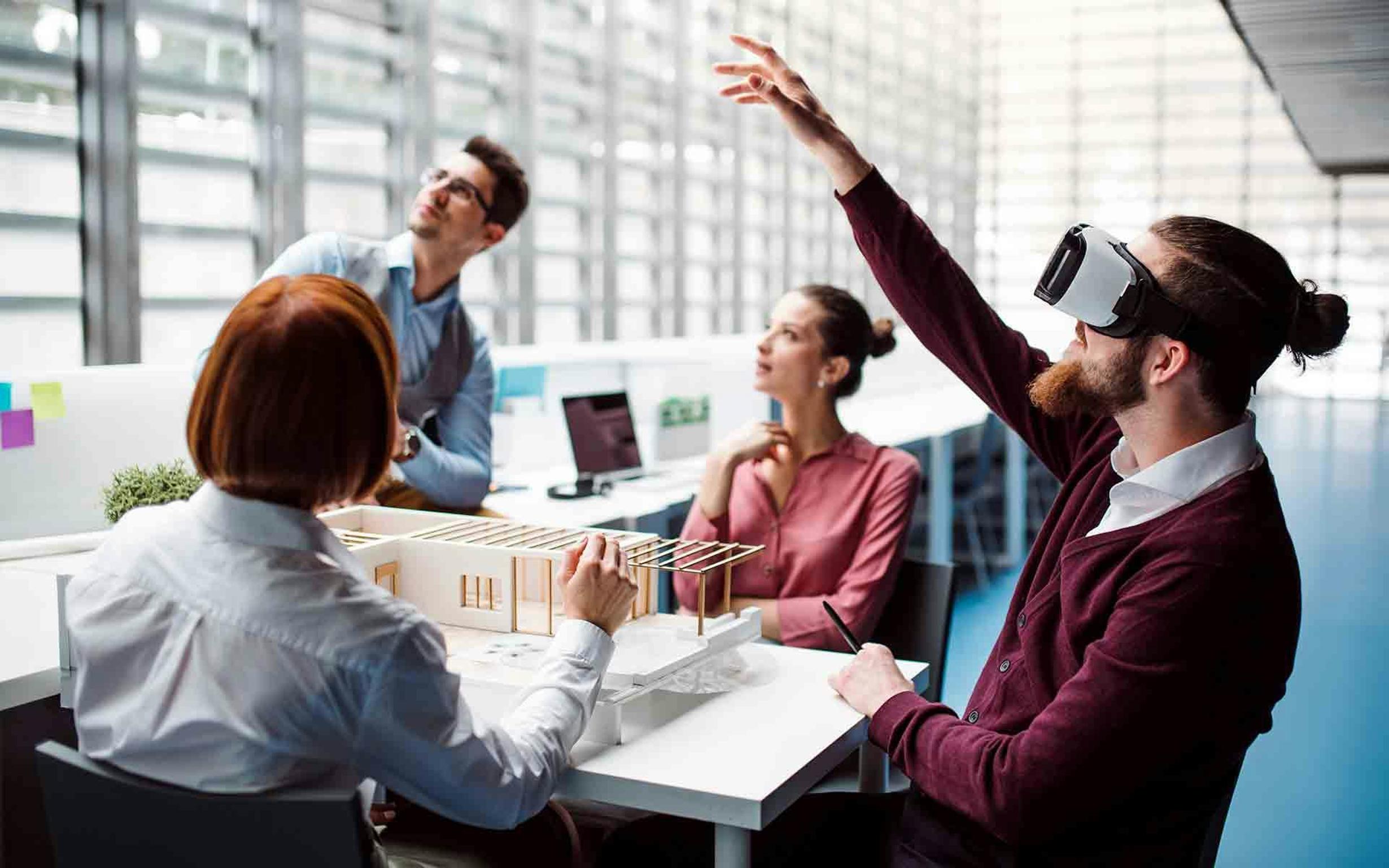
Digital technologies have transformed the way many sectors produce and work. Among these technologies, Virtual Reality and Augmented Reality have significantly improved the way completed tasks are visualised and validated, even increasing companies' productivity. In the architecture sector, Virtual Reality stands out in particular, a technology that makes it possible to improve previously created 3D designs and to visualise much more accurately the final result of a house, building or structure to be built.
How is Virtual Reality used in architecture?
In recent years, Virtual Reality in Architecture has evolved into a very valuable tool that benefits every area of any project. From the planning stages through to project completion and beyond.
The technologies used in Virtual Reality, such as Building Information Model (BIM) software, allow you to understand each process much better, which in turn helps you to deliver a better design and, more importantly, to improve communication and collaboration with your clients.
Thus, Virtual Reality in architecture is used before starting a project, studying and calculating the elements that will later form part of our design. You can also use it during the design of the project itself, validating measurements and reducing possible errors. And above all, once the design is finished, Virtual Reality is a great support for showing the architectural project to clients, collaborators or even the builders of the work.
Benefits of applying Virtual Reality in architecture
Aside from boosting and promoting productivity, Virtual Reality applied in architecture offers other great benefits:
- Personalisation of the individual experience
With these solutions you can involve your clients in a completely immersive environment. In this way, they will visit their future home, change finishes, combine colours, and so on. In other words, they will feel part of the project. - Simulation of real-world scenarios
With this technology you can explore and improve the initial design by creating a real experience. For example, imagine you are building a public building: with this resource you can simulate possible evacuation routes in the event of an emergency, in order to choose the most suitable option. Likewise, Virtual Reality can help you better understand the effects of glare, the distribution of light and the compensation of artificial light to promote energy saving. - Construction training
During the construction phase, Virtual Reality can provide a training ground for new construction workers. Accordingly, Virtual Reality applications act as a proactive approach that translates into efficiency and, above all, safety. - Savings
While it is true that Virtual Reality technology requires an upfront investment, we are convinced that the ROI (return on investment) it will provide will more than make up for it. Property viewings are a good example. You will be able to show any project from the office without having to travel, or even online. - Competitive advantage
They say nothing ventured, nothing gained. In this sense, being one of the first on the market can reward you in terms of brand recognition. Remember that we are talking about very new technologies in the architectural field, but their status as a disruptive technology is undeniable. Therefore, it may be the ideal time to take the big step towards Virtual Reality in your company.
Other applications of Virtual and Augmented Reality in the workplace
As businesses consider new applications, developers are improving the tools to try to help them. But one thing is clear to us: the use of both solutions can be extended to almost any sector:
- Design departments
- Logistics and warehouse management
- Simulation of dangerous situations
- Industrial Maintenance
- Museums
- Cultural heritage
- Education
- Advanced information visualisation
- Product catalogue
- Training and protocol
If your company is currently using 3D models and other methods to present architectural projects to clients, it is time to jump on the Virtual Reality and Augmented Reality bandwagon. If you don't know where to start, at INVELON Technologies we are ready to help you.