How to minimise risks in the chemical industry with Virtual Reality training
Thanks to Virtual Reality, simulations of risk situations can be carried out without the danger of the real situation.
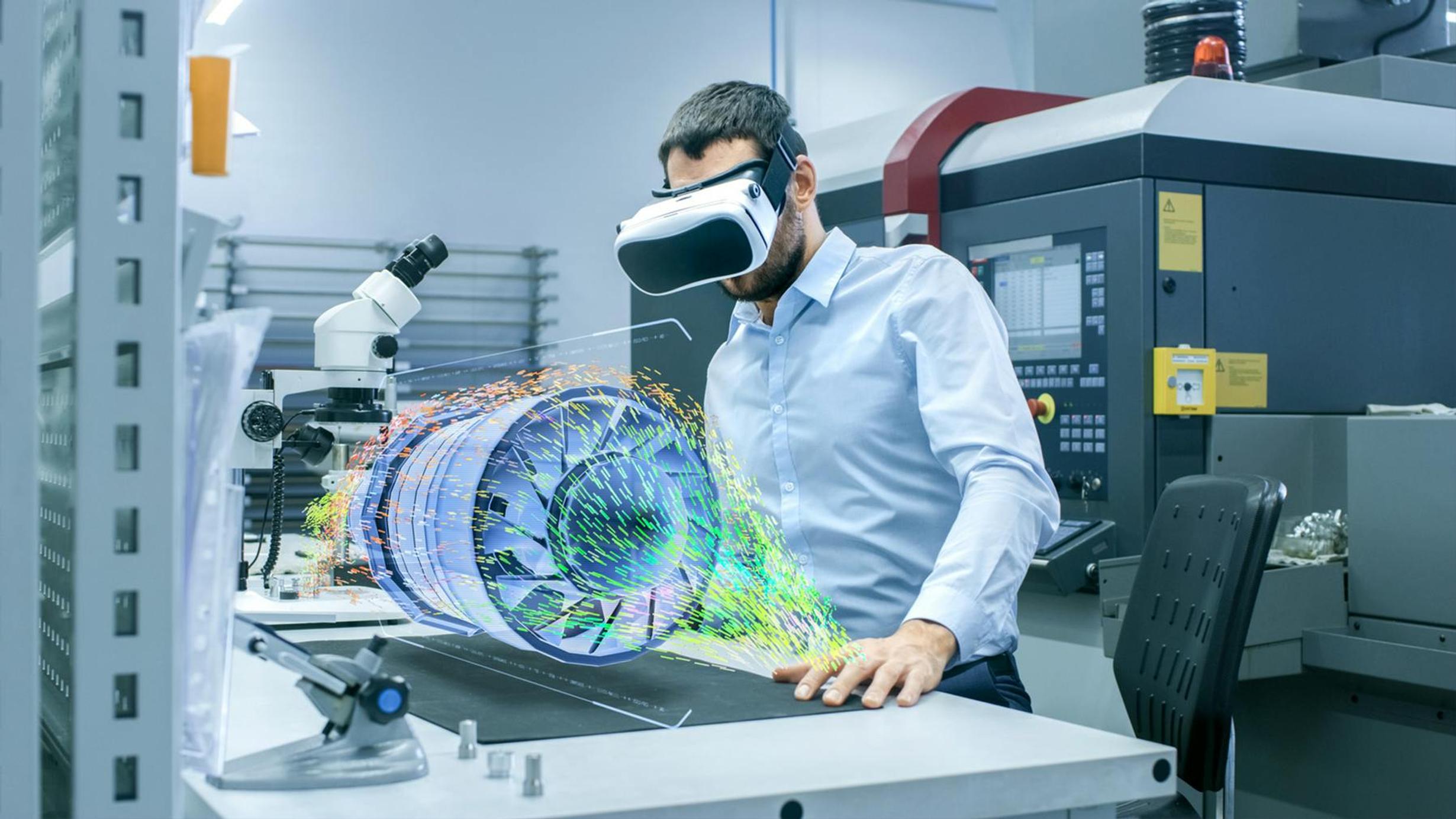
As we have already told you in other blog posts, Virtual Reality is being introduced into various areas of industry, such as Field Service, training, product validation, maintenance and repairs and, now, also the handling of chemical substances.
In the chemical industry, workers constantly face risk situations, such as fires, explosions, poisoning, leaks or confined spaces. For this reason, companies in this sector must prioritise workforce training, thus guaranteeing the health and safety of their employees, with the aim of preventing these situations.
This is why, to prevent and minimise risks, the chemical industry must focus on ensuring that its employees learn to avoid dangerous situations, helping them acquire enough knowledge to respond in complete safety if they do happen. However, the industry faces the problem of not being able to recreate certain situations because of the danger they involve.
We are at a time of great boom for Virtual Reality, as it is a technology with no limits for industry. And that is because, nowadays, for things to exist in the real world, they must first be tested in a virtual environment. So imagine what it would be like to have a “digital twin” of your chemical industry in the metaverse. Processes would be simplified and your company could solve many of the problems involved in training new workers, with the possibility of setting out possible virtual scenarios and situations very close to reality.
How to apply Virtual Reality training in the chemical industry
Companies that in their day-to-day work with chemical products are exposed to fires, explosions and poisoning. This is why training programmes for working with highly dangerous chemicals are indispensable in an industry such as the chemical industry. So is training workers to prevent this type of accident and to know how to act should they occur.
Given the impossibility of running simulations with real chemical substances, because of the danger they involve, the safest alternative is the immersive reproduction of real situations through Virtual Reality. In this way, workers will be able to learn to identify risks, learn good practice, know how to act in the event of possible accidents and put their learning into practice, without putting their safety at risk.
It is thanks to the effectiveness of Virtual Reality training that the risks employees face in their day-to-day work are minimised.
In addition, workers will not only know what to do in certain situations, but Virtual Reality allows them to see, hear and feel the simulations in the first person and in a completely immersive way. Therefore, the result is highly trained employees in risk positions, who are able to respond quickly to any danger or setback that could affect their health and/or safety.
Whether they are workers already in the chemical industry, new workers starting in a position that involves a certain amount of risk, or students having their first contact with the industry, they must be 100% prepared to handle any setback that occurs during their working day.
Virtual Reality training for the chemical industry is highly immersive and makes it possible to add different resources when presenting information: step-by-step tasks, infographics, videos, images, 3D models, animations, voice commands… Ultimately, this means the training can be 100% customised, according to the needs and requirements of each company.
Applications of Virtual Reality in the chemical industry
Virtual Reality can be applied in several areas of the chemical industry, as it is a very useful tool for solving a range of problems. Below, we share some examples of the most common applications:
- Simulations that are impossible to recreate without risk
It is thanks to Virtual Reality that risk situations such as chemical emergencies, explosions or leaks can be reproduced, so that all staff know how to react to them.
- Training for workers and students
It is very important to train new workers entering the chemical industry thoroughly, as they will have to handle hazardous chemical substances, boilers and reactors that can endanger their own health and that of other employees. The same goes for students, who need to know all the risks of the industry 100%, for their training and knowledge, but also for their later entry into the sector.
- Handling toxic products
In a chemical laboratory there are countless things to be careful about, whether objects that are dangerous if not used properly, such as toxic chemical substances or flammable materials.
- Protecting health and safety in laboratories
In the chemical industry, you have to look after workers' health, but also the safety of laboratories, materials and instruments.
- Maintenance, remote support and knowledge transfer
In addition to Virtual Reality training for new professionals, Virtual, Augmented and Mixed Reality are extremely useful technologies for carrying out machinery maintenance and repairs remotely. They are also useful for receiving technical support from professionals at other plants. In this way, thanks to these technologies, we save on unnecessary travel and help reduce our carbon footprint.
Benefits of applying Virtual Reality in the chemical industry
Here are the benefits you will bring to your chemical company if you opt for Virtual Reality to train workers for risk situations:
- Fewer accidents and/or occupational risks
- Makes training easier and faster
- Fewer staff needed for training
- Standardises procedures and replaces physical manuals
- Reduced costs and time spent on training
- Physical barriers no longer exist
- Ability to assess users
- Lower costs compared with paper manuals
- Virtual content can be played back countless times, unlike live training
- Reports on the users who take part in training sessions
- Unnecessary travel is avoided, thereby reducing the carbon footprint
At Invelon we offer Virtual Reality Training Capsules for chemical industry companies
At Invelon we have a Virtual Reality solution called Training VR, which aims to help companies in different industries create a classroom for the training of workers in their specialist field.
Training VR is a tool within everyone's reach that can be customised for a large number of industries, through which the facilities of a real situation are recreated, but without the costs and risks of a live simulation. In this way, thanks to Virtual Reality, workers or students improve their skills and abilities, experiencing the risks first-hand and acting in dangerous situations.
To train employees in Virtual Reality, you will only need the training capsules and the hardware. We also advise you on this and provide the one best suited to your needs, so that the experience is 100% effective in your company.
Hardware recommendations to go with the Training VR solution for the chemical industry
The sensors in Virtual Reality headsets such as the HP Reverb G2 Omnicept Edition make it possible to create training experiences centred on the user and their stimuli, as they feature face and eye tracking technology, in order to understand trainees' reactions to certain risk situations.
In addition, this HP model has a facial camera that captures the physiological responses of those using the headset, which are then analysed by developers, in order to create Virtual Reality experiences entirely centred on the user and their reactions.
Case study from our clients in the chemical sector
We are sharing one of the projects we have co-created with several Vocational Training centres such as Guindavols in Lleida, IES Virgen Pilar in Zaragoza and CIPFP Canastell, in collaboration with the companies Johnsson Controls, Danfoss, Eurammon, AEFYT and IIAR, among others.
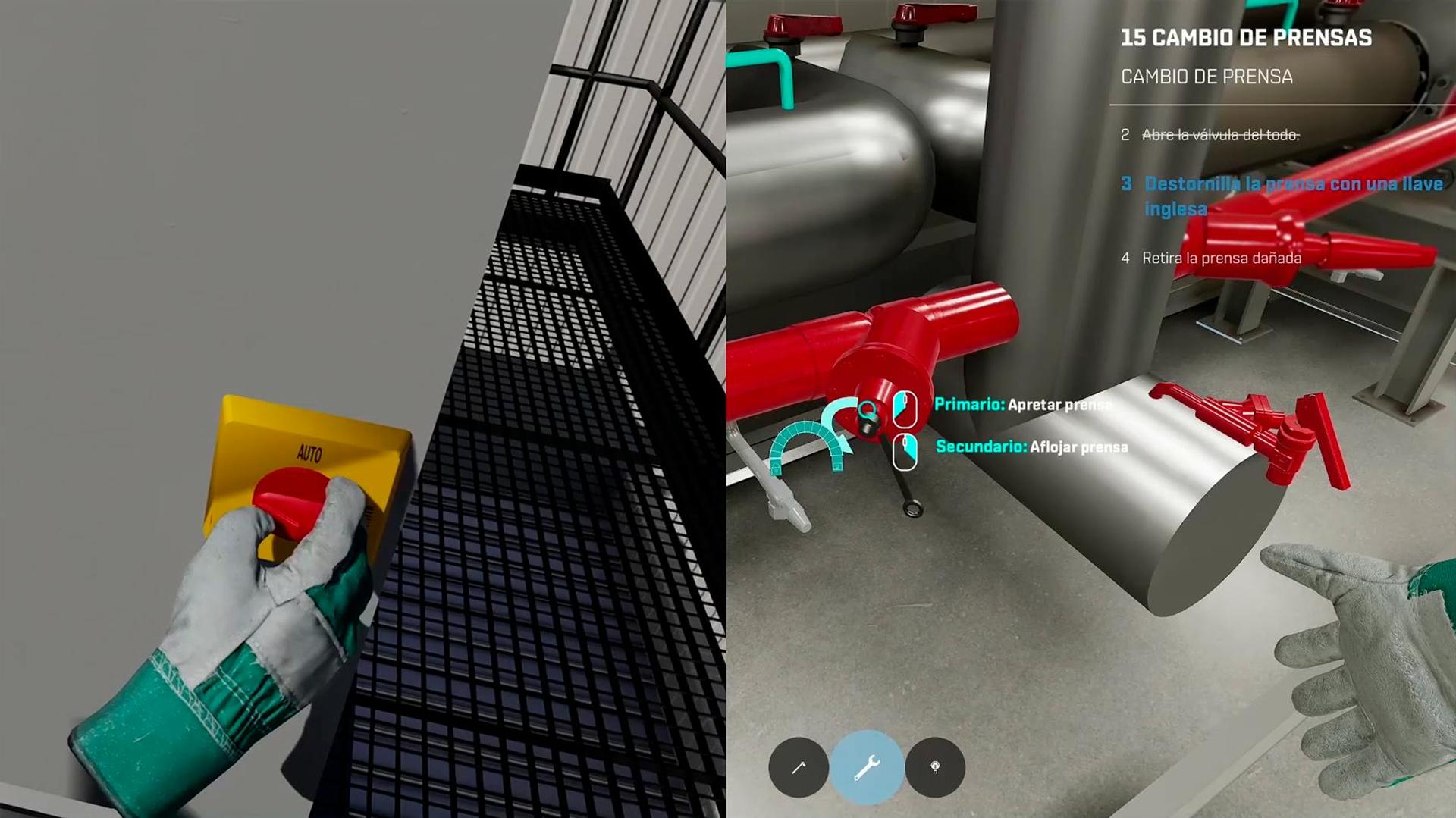
It involves creating a Virtual Reality classroom for training students in the installation of highly hazardous chemical products, more specifically for industrial refrigeration installations using ammonia.
Through the Training VR solution, we created a Virtual Reality classroom so that students could learn the tasks step by step and unassisted, without the dangers of a real situation. In this way, students' learning curve improves and knowledge is digitised.
These new ways of working will gradually become established in chemical industry companies, above all after the pandemic, which has reminded us of the importance of being digitally connected so that companies can keep operating normally.